
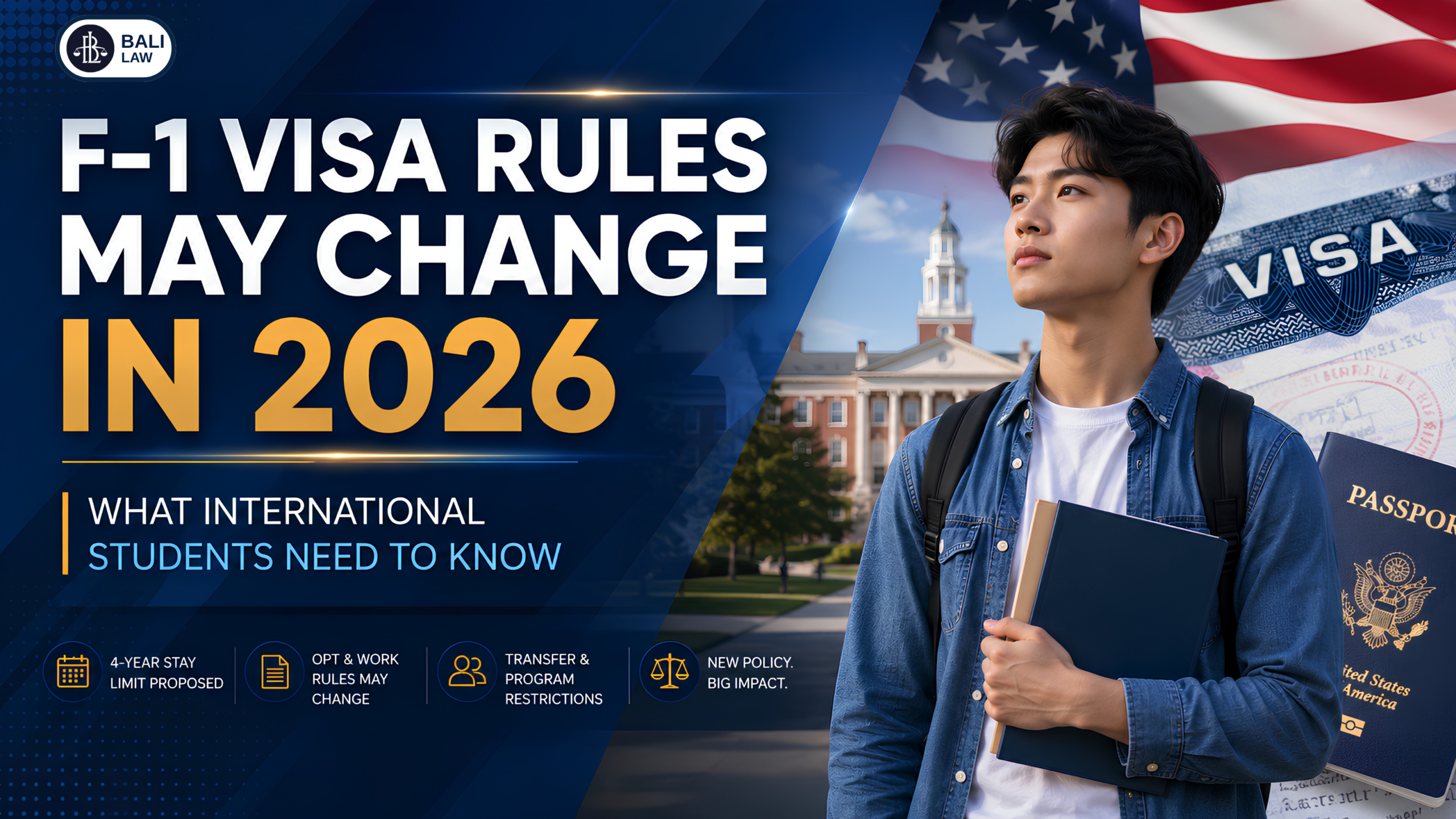
If you’re an international student in the U.S. on an F-1 visa — or planning to study here — a major policy change is coming that could affect your ability to stay, work through OPT, or finish your degree. This guide explains what’s changing, who is affected, and what steps to take right now.
It is important to note that this rule has NOT been finalized or enacted yet. Your current Duration of Status (D/S) remains fully valid today. This article explains a proposed rule still under White House review. No action is legally required right now — but early preparation is strongly advised.
Updated May 18, 2026, | Attorney-reviewed | 6 min read | Priyanka Kotak, Bali Law USA
What Is Actually Changing
What the New Rule Would Do
Right now, your F-1 visa works on something called “Duration of Status” (D/S). It means stay enrolled in school and follow the rules, and you can remain in the U.S. There is no expiration date stamped on your legal status.
The new rule would end that system entirely. Instead, you’d receive a fixed end date — a maximum of 4 years from the day you enter the U.S. After that, you’d need to apply to the government for more time — even if your degree program isn’t finished yet.
The 5 Biggest Changes Explained Simply
1. 4-Year Hard Limit on Your Stay
Your I-94 entry record will show an expiration date — no more open-ended status. If your program takes longer than 4 years (very common for PhD, medicine, and law), you must apply to USCIS for an extension or you risk falling out of legal status.
2. Your University Can No Longer Extend Your Stay
Right now, your school’s international student office handles your status extensions. Under the new rule, only U.S. immigration authorities (USCIS) can approve extra time.
You will need to file paperwork, pay $420–$470 in fees, and attend a biometrics appointment.
3. Changing Schools or Programs Gets Harder
Undergrads cannot transfer schools or switch majors during their first year. Graduate students cannot change programs at all once enrolled.
Moving from a bachelor’s to a master’s may require USCIS approval if it pushes you past 4 years total.
4. OPT Work Authorization Gets Complicated
If your I-94 expires before your OPT work permit (EAD), you could lose the right to work — even if the card is still valid.
You would need to file a separate extension just to continue working legally.
5. Grace Period After Graduation Cut to 30 Days
Currently you have 60 days after finishing your program to apply for OPT, find a job, or arrange your departure.
The proposed rule cuts that to 30 days — half the time, the same number of decisions.
DOES THIS AFFECT YOU?
Who Is Most at Risk?
Not every student faces the same level of risk. Here’s a quick breakdown:
HIGH RISK
PhD and doctoral students whose programs run 5–7 years. You will almost certainly need a USCIS extension mid-program.
WATCH CAREFULLY
Students moving from bachelor’s to master’s programs. If the combined timeline exceeds 4 years from U.S. entry, you’ll need to file an extension.
OPT WORKERS
Your work authorization could become void if your I-94 expires before your EAD. Alignment filings will be required.
PLANNING TO TRANSFER
Transfers in your first year as an undergrad
— or at any point as a grad student — will be blocked or restricted.
THE TIMELINE
What Happens Next — and When
AUGUST 2025
DHS first proposed the rule. Over 34,800 comments were submitted — mostly against it — from universities, educators, and students.
MAY 5, 2026
DHS submitted the final rule to the White House Office of Management and Budget (OMB) the last step before it becomes official policy.
LATE MAY – JUNE 2026
OMB review expected to conclude. Once published in the Federal Register, a 30 to 60-day countdown begins before the rule takes legal effect.
SEPTEMBER 2026 (PROJECTED)
Effective date for incoming students. The government wants this in place before fall semester begins. Current students may have a transition period, but no automatic protection has been confirmed.
Not sure how this rule affects your specific situation?
Every student’s timeline, program, and visa history is different. Our attorneys at Bali Law
USA can review your status, flag risks specific to you, and help you build a plan — before
the deadline hits.
YOUR ACTION PLAN
What You Should Do Right Now
The rule is not final yet — but waiting is a mistake. Here’s what proactive students and families should be doing today:
✓ Find your program end date on your I-20 and note it somewhere safe.
✓ Calculate whether your full academic path exceeds 4 years from your U.S. entry date.
✓ Talk to your DSO (international student office) about your specific timeline.
✓ If you’re near graduation, start your OPT application early — don’t wait for the 60-day window.
✓ Do NOT travel internationally if your immigration status situation is uncertain.
✓ Consult an immigration attorney to review your specific case and plan next steps.
COMMON QUESTIONS
Frequently Asked Questions
Is the rule already in effect? Do I need to do anything right now?
No — the rule is not yet in effect. Your current Duration of Status framework still applies today. However, the government is moving quickly, and a September 2026 effective date is widely expected. The time to prepare is now, not after it is published.
I’m already in the U.S. on F-1. Will I be automatically protected?
This is still unclear — the final rule text has not been published. The current proposal suggests current students would have a transition period, but no automatic grandfathering has been confirmed. If your program extends beyond 4 years from your entry date, speak with an attorney now.
What is Form I-539, and will I need to file it?
Form I-539 is the application to extend or change your nonimmigrant status. Under the new rule, any F-1 student whose program runs beyond their 4-year admission period would need to file I-539 with USCIS — pay a fee (currently $420–$470), submit documents, and attend a biometrics appointment. Processing times are already several months long, so early planning is critical.
What happens to my OPT if this rule passes?
OPT and STEM OPT would still exist, but your I-94 expiration date could become a problem. If your I-94 expires before your Employment Authorization Document (EAD), your work authorization could effectively become void — even if the EAD card says it’s valid. You’d need to file an I-539 extension to align the two documents. USCIS Director Edlow has also signaled that further OPT restrictions may follow separately.
Can the rule be challenged in court?
Yes — legal challenges are widely expected from universities, advocacy groups, and affected individuals. The most likely argument is that the rule is arbitrary and capricious under the Administrative Procedure Act. However, legal battles take time, and you should not rely on a court injunction to protect your status. Have a legal plan regardless.
Bali Law USA — Immigration Attorneys for International Students
Immigration rules are changing fast. Whether you’re a current student, a new arrival, or a
family navigating this for the first time, our team is here to help you understand your rights,
protect your status, and plan for whatever comes next.
Schedule a call: 862 217-4615
Email us:
sbali@balilaw.com
Confidential consultation · No obligation · Response within 24 hours
————————————————————————————————————————————–
Legal Disclaimer: This article is for general informational purposes only and does not constitute legal advice. Immigration law is complex and fact specific. Nothing in this content creates an attorney-client relationship. For advice specific to your situation, please consult a qualified immigration attorney at Bali Law USA.
Stay tuned for more such updates and reach out to Bali law for any of your immigration needs!