
On May 21, 2026, U.S. Citizenship and Immigration Services (USCIS) issued Policy Memorandum PM-602-0199, titled “Adjustment of Status is a Matter of Discretion and Administrative Grace, and an Extraordinary Relief that Permits Applicants to Dispense with the Ordinary Consular Visa Process.” The agency’s accompanying public statement indicated that USCIS will grant adjustment of status “only in extraordinary circumstances.”
The announcement has generated significant discussion across the immigration community. This post provides an overview of what the memo says, how it fits within existing law, and what it may mean for applicants currently navigating the green card process.
When a foreign national already inside the United States qualifies for lawful permanent residence — through marriage to a U.S. citizen, an employer petition, family sponsorship, or another basis — there are two general paths to a green card:
AOS has historically been the preferred route for many applicants, as it allows them to remain in the U.S. throughout the process. The new memo addresses how USCIS officers should exercise their discretion when adjudicating I-485 applications.
It is worth clarifying what the memo is and is not.
It is not a new law. Adjustment of status remains available under Section 245 of the Immigration and Nationality Act, and Form I-485 remains an active USCIS form. USCIS still lists AOS as one of the two ways to apply for a green card.
What the memo does is reinforce USCIS’s discretionary authority at the final adjudication stage. Under existing law, a USCIS officer has always had the authority to deny an AOS application on discretionary grounds, even when an applicant is technically eligible. The memo instructs officers to give that discretion more deliberate weight — reviewing all relevant positive and negative factors before approving a case.
The memo does not include a prospective-only effective date, which means it applies to pending I-485 applications as well as new filings. This is in contrast to some other recent USCIS policy changes that explicitly limited their scope to cases filed after a certain date.
The memo also notes that H-1B and L-1 workers and their dependents may be less affected, given the dual-intent provisions that apply to those visa categories.
To understand the scope of this change, it helps to look at how adjustment of status has been used in practice. In FY2023, USCIS issued 1,173,000 green cards in total. Across the major categories, a significant share were processed via AOS:
These figures illustrate how widely AOS has been used across different immigrant categories, and why changes to how it is adjudicated can affect a large number of applicants.
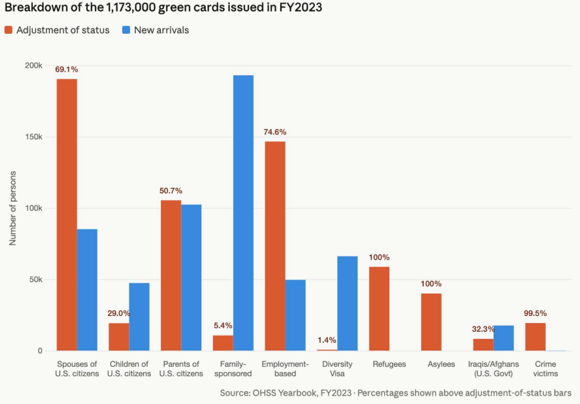
Source: OHSS Yearbook, FY2023
Based on the memo and USCIS’s existing policy framework, officers adjudicating I-485 applications are expected to weigh both positive and negative factors. Positive factors generally include:
• Length of lawful residence in the United States
• Family ties to U.S. citizens or lawful permanent residents
• Employment history and community contributions
• Compliance with tax obligations
• Evidence of good moral character
Negative factors may include prior immigration violations, periods of unlawful presence, criminal history, or other conduct that raises concerns about admissibility or discretion. The memo does not specify a numerical standard or enumerate exactly which combinations of factors lead to approval or denial — the assessment remains case-by-case.
For individuals with a pending I-485 or those preparing to file, a few considerations are worth keeping in mind:
• Review your immigration history. Any prior periods of unlawful presence, prior visa violations, or other complications are worth evaluating carefully. These factors are likely to receive more attention under the new guidance.
• Document positive factors thoroughly. Strong applications have always included clear evidence of eligibility and favorable equities. Under the heightened discretionary standard, thorough documentation becomes even more important.
• Consider your options. In some situations, consular processing may be worth evaluating as an alternative. In others, AOS may still be the most appropriate path. The right choice depends on the specifics of each case.
• Monitor legal developments. Several legal challenges to the memo are expected. How courts interpret USCIS’s authority to reframe adjustment of status in this way will likely affect how the policy is implemented going forward.
The May 2026 memo is consistent with a series of USCIS policy memoranda issued since August 2025, which have collectively emphasized expanded officer discretion across various benefit categories — including general adjudications and naturalization. The practical effect of those earlier memos has varied, and it remains to be seen how officers will apply the new AOS guidance in individual cases.
What is clear is that the standard for AOS applications has shifted, at least in terms of how officers are being directed to approach them. Applicants and their counsel will need to prepare accordingly.
If you have questions about how this memo may affect your case or your options going forward, we encourage you to reach out. Our team is available to review your situation and help you understand the path forward.
This blog post is for informational purposes only and does not constitute legal advice. Immigration law is highly fact-specific. Please consult a licensed immigration attorney regarding your individual circumstances.